In This Article:
- Introduction
- Understanding Technology Decision Making Challenges
- How IT Consulting Services Address Technology Decision Making
- Data-Driven Decision Making in IT Consulting
- The IT Consulting Decision-Making Process
- Common Technology Decision Challenges and Solutions
- Conclusion and Next Steps
- Additional Resources
Introduction
IT consulting services provide independent expertise that transforms technology decision making from risky guesswork into strategic advantage. In today’s business environment, technology consulting and tech consulting play a crucial role in helping organizations stay competitive by aligning technology initiatives with business goals and adapting to rapid innovation. When business leaders face critical technology investments without extensive technical backgrounds, consulting firms bridge the gap between complex technical options and clear business outcomes.
This guide covers strategic technology evaluation, vendor selection processes, and implementation planning specifically for business executives and decision makers researching technology investments. IT consultants are experienced in advising businesses and supporting business operations by providing strategic guidance that enhances efficiency and drives growth. Whether you’re considering cloud computing migrations, cybersecurity solutions, or enterprise resource planning systems, understanding how IT consultants help businesses navigate these decisions prevents costly mistakes and accelerates business growth.
Direct answer: IT consulting services help with technology decision making by providing independent expertise to evaluate technology options objectively, align solutions with business objectives, and mitigate investment risks through structured assessment frameworks and proven methodologies.
By reading this guide, you will gain:
- Strategic alignment frameworks that connect technology investments to measurable business goals
- Cost optimization strategies including total cost of ownership analysis and budget planning
- Risk mitigation approaches that prevent expensive implementation failures
- Vendor evaluation criteria for comparing solutions without internal bias
- Implementation roadmaps that sequence technology initiatives for maximum impact
IT consulting is particularly valuable for small businesses, which may not have full-time IT staff and need expert guidance to make informed technology decisions.
As businesses face increasingly complex technology challenges, the demand for IT consulting services continues to grow, making expert advice essential for maintaining a competitive edge.
Understanding Technology Decision Making Challenges
Modern technology decision making presents significant complexity that business leaders must navigate carefully. Poor technology decisions can negatively impact operational efficiency by disrupting workflows, causing bottlenecks, and hindering business performance. With thousands of software solutions, multiple cloud platforms, and evolving cybersecurity requirements, selecting the right technology investments demands both technical expertise and strategic business thinking that many organizations lack internally.
A mismatch between IT and a business’s strategic goals can lead to inefficiencies and overspending, making it crucial to align technology initiatives with organizational objectives.
Additionally, project management is a key challenge in technology decision making, as organizations must effectively manage timelines, resources, and deliverables to ensure successful implementation of chosen solutions.
Technology Complexity and Overwhelming Options
Technology complexity in today’s business environment refers to the exponential growth of available solutions combined with rapidly evolving capabilities that make evaluation increasingly difficult. Business leaders often face dozens of competing vendors, each claiming unique advantages through technical specifications that require deep understanding to evaluate properly.
Common decision paralysis scenarios include choosing between cloud computing platforms like AWS, Azure, or Google Cloud without clear criteria for comparison. Cloud consultants play a key role in helping businesses evaluate, select, and transition to the right cloud solutions, ensuring a smooth migration and planning for scalable growth. Similarly, cybersecurity consulting decisions involve evaluating advanced security technologies with overlapping capabilities. Enterprise resource planning selections require understanding how different software solutions integrate with existing systems and support future growth.
This complexity directly impacts decision quality and timeline. Organizations without structured evaluation processes often delay critical technology investments or rush decisions based on incomplete information, leading to implementations that fail to support business growth. Cloud computing and hybrid solutions are a top focus for IT consulting firms as businesses seek flexibility.
Risk of Wrong Investment Decisions
Technology investment risks encompass both direct financial losses and indirect costs that compound over time. Research indicates that 85% of software projects face significant issues or fail entirely, with a substantial portion attributable to poor initial decision making and inadequate vendor evaluation.
Real costs of wrong decisions extend far beyond wasted purchase prices. Productivity loss occurs when technology systems fail to streamline operations as promised. Competitive disadvantage develops when competitors implement technology solutions that enhance productivity while your organization struggles with inadequate tools. Data breaches from poorly evaluated cybersecurity solutions can devastate business performance and customer trust. IT consultants help enhance security by recommending and implementing advanced cybersecurity measures, such as AI-driven monitoring and blockchain solutions, to protect sensitive data and ensure compliance.
These risks amplify with technology complexity because more options create more opportunities for misalignment between solutions and actual business needs. IT consultants help businesses implement robust cybersecurity measures to protect sensitive data.
Limited In-House Technical Expertise
Expertise gaps in typical business organizations occur because internal IT teams specialize in maintaining current IT infrastructure rather than evaluating new technologies across the broader market. Most in-house teams lack exposure to how similar problems are solved across different industries, limiting their ability to identify innovative solutions. As a result, many businesses are hiring consultants with specialized expertise in areas like AI and machine learning to help implement and leverage these advanced technologies for better operations, customer service, and decision-making.
Additionally, internal recommendations may be influenced by existing vendor relationships or departmental preferences rather than objective analysis of what best serves business objectives. This is where IT consulting services provide critical value by introducing external perspective and broader industry experience.
AI and machine learning are rapidly changing how businesses use IT consulting, driving demand for consultants who can guide companies through adopting these technologies. The need for AI consulting is expected to grow as organizations look to improve operations and customer service through advanced technology solutions.
How IT Consulting Services Address Technology Decision Making
IT consultants directly address the challenges outlined above through structured methodologies that translate business needs into technical requirements while eliminating bias from the evaluation process. Management consultants also play a crucial role in overseeing complex technology projects, ensuring alignment with organizational strategies and successful execution across business functions.
When selecting an IT consulting firm, it is important to consider the firm’s reputation and experience to ensure the best outcomes. Effective communication and collaboration are also key when working with IT consultants to achieve successful technology decision making.
Strategic Alignment and Requirements Analysis
Strategic IT consulting begins by establishing explicit business goals before evaluating any technology options. Unlike tech consulting, strategy consulting focuses on integrating technology decisions into the broader business strategy, ensuring that technology investments align with long-term organizational objectives. This “business first, technology second” approach prevents organizations from investing in sophisticated tools that don’t advance measurable priorities.
Consultants assess current business processes, identify growth objectives, and translate these into technical requirements that guide solution evaluation. For example, a financial services company seeking digital transformation might define requirements around data security, regulatory compliance, and scalability before comparing platforms.
Alignment frameworks used by technology consultants typically include stakeholder interviews, process mapping, and gap analysis between current capabilities and desired outcomes. This ensures every technology recommendation directly supports business success rather than implementing technology for its own sake.
Looking ahead, the integration of AI-driven consulting is emerging as a significant future trend in strategic IT consulting, enabling even more data-driven and adaptive technology decision-making.
Independent Technology Evaluation
IT consultants offer unbiased recommendations because they are not tied to your internal politics or vendor preferences. This objectivity proves particularly valuable in organizations where particular technology ecosystems have institutional momentum that may not reflect current optimal solutions.
When evaluating cloud solutions, data management platforms, or software development tools, consultants bring experience from multiple client engagements across industries. They have observed how similar challenges are solved in different sectors, identifying best practices that internal teams might never discover. In particular, consultants leverage data analytics to interpret large datasets, providing strategic insights and identifying trends that inform technology decision-making.
This independent perspective directly supports risk management by ensuring evaluation criteria focus on business fit rather than relationship history with specific vendors. Consultants also help businesses implement data management and analytics solutions, enabling organizations to make more informed decisions based on actionable insights.
Cost-Benefit Analysis and ROI Projection
Technology consultants calculate total cost of ownership that includes factors internal teams often overlook: implementation costs, integration work, employee training requirements, ongoing support expenses, and licensing complexity over multi-year periods.
Methods for comparing investment scenarios include scenario modeling that projects costs and benefits across different implementation timelines and adoption rates. Consultants help businesses understand that cost-effective solutions differ from cheapest solutions—sometimes higher upfront investment delivers significant cost savings through lower total ownership costs.
Budget optimization strategies might include phased implementations that spread costs while delivering early value, or identifying existing systems that can be enhanced rather than replaced entirely. IT consultants also ensure that technology infrastructure is scalable and can handle increased demand as the business grows, helping maintain performance and avoid bottlenecks during expansion.
IT consulting services should provide a comprehensive range of solutions to meet specific business needs.
Data-Driven Decision Making in IT Consulting
In today’s fast-paced digital landscape, data-driven decision making has become essential for organizations seeking to achieve business success and sustainable growth. IT consulting services play a pivotal role in helping businesses harness the power of data to inform strategic decisions, optimize operations, and gain a competitive edge. By leveraging the expertise of an IT consulting firm, organizations can transform raw data into actionable insights that directly support their business objectives.
IT consultants help businesses collect, analyze, and interpret data using advanced analytics tools and machine learning algorithms. This enables organizations to uncover valuable insights from their operations, customer interactions, and market trends. By implementing robust data management strategies, consultants ensure that businesses have access to accurate, timely, and relevant information to guide their technology investments and business processes.
A key advantage of working with consulting firms that have a proven track record in data management and analytics is their ability to assess the current IT infrastructure and identify opportunities for improvement. IT consultants collaborate with stakeholders to develop tailored solutions that address specific business needs, whether it’s enhancing data security, streamlining operations, or supporting future growth. By integrating cloud computing and advanced security technologies, consultants help businesses protect sensitive data, prevent data breaches, and ensure business continuity.
The IT Consulting Decision-Making Process
Building on evaluation methods, IT consulting firms follow structured processes that ensure thorough analysis while respecting business timelines and resource constraints. Technology consulting provides these structured processes, helping organizations align technology decisions with business goals, improve efficiency, and reduce risks.
Ongoing IT support and maintenance from IT consultants are essential for long-term success, ensuring that technology solutions continue to meet evolving business needs.
Technology Assessment and Planning Process
Organizations should engage this structured approach when facing technology investments with significant financial impact, strategic importance, or technical complexity that exceeds internal expertise.
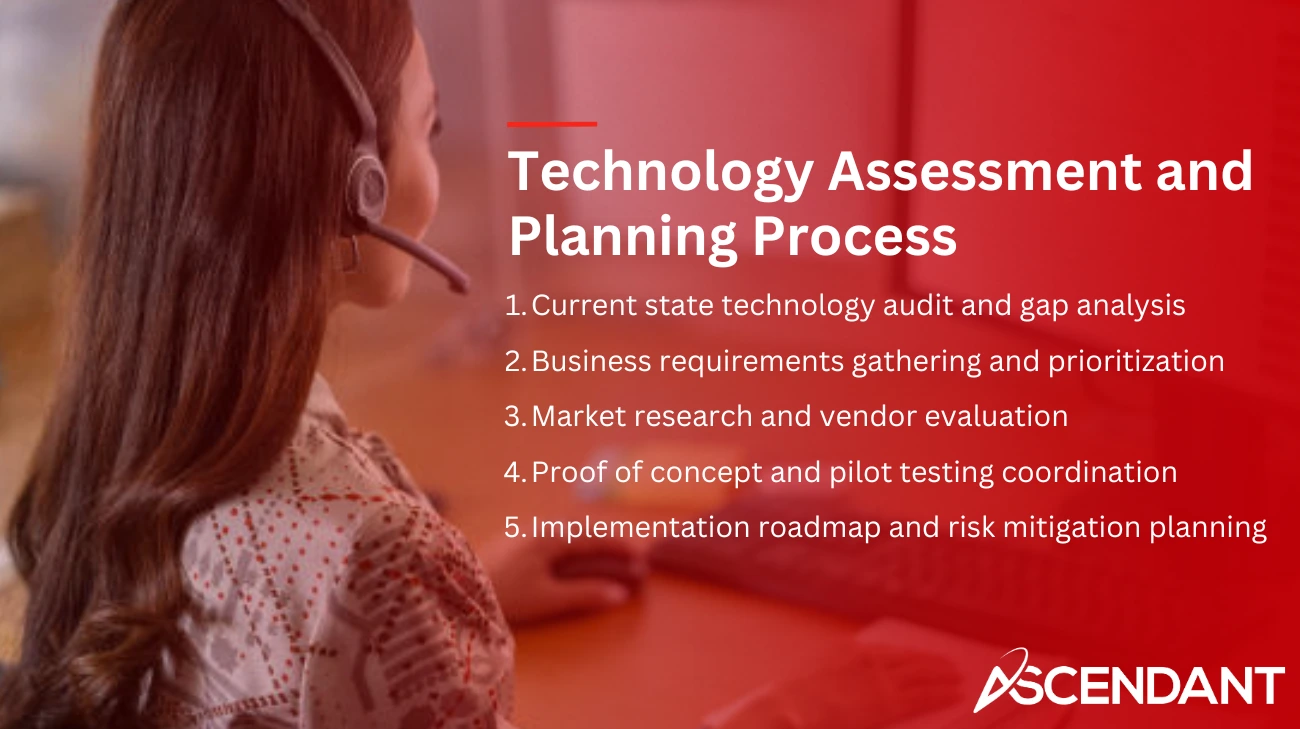
- Current state technology audit and gap analysis — Consultants assess existing systems, identify where technology is not supporting business growth, and document integration points that new solutions must accommodate.
- Business requirements gathering and prioritization — Through stakeholder collaboration, consultants capture business needs across departments, prioritizing requirements by business impact and feasibility.
- Market research and vendor evaluation — Consultants leverage industry relationships and proven track record of evaluating solutions to identify qualified vendors, eliminating unsuitable options before detailed comparison.
- Proof of concept and pilot testing coordination — Before full commitment, consultants help businesses test solutions in controlled environments, validating that technology delivers promised capabilities.
- Implementation roadmap and risk mitigation planning — Final recommendations include sequenced implementation steps, resource requirements, and contingency plans that ensure business continuity throughout transition.
Decision Framework Comparison
| Criterion | Internal Decision | Consultant-Guided Decision |
|---|---|---|
| Speed | Fast initial decision | Thorough but structured timeline |
| Upfront Cost | Lower immediate cost | Investment in expertise |
| Risk Level | Higher risk of poor fit | Mitigated through evaluation |
| Expertise Applied | Limited to internal knowledge | Broad industry experience |
| Bias Consideration | Influenced by existing relationships | Independent perspective |
Organizations should choose consultant-guided approaches when technology investments are substantial, when internal expertise gaps are significant, or when wrong decisions would create competitive disadvantage. Internal decisions may suffice for routine technology purchases with limited business impact.
Common Technology Decision Challenges and Solutions
IT consultants routinely address obstacles that derail technology decision making in organizations lacking external guidance. By supporting and optimizing business operations, IT consultants help ensure that technology aligns with and enhances core business functions. They also help businesses make better decisions by teaching them the right way to manage their data, enabling organizations to extract useful information and insights for improved decision making.
Analysis Paralysis from Too Many Options
Solution: Consultants create decision matrices with weighted criteria aligned to business objectives, rapidly eliminating unsuitable options. Rather than evaluating dozens of vendors, consultants focus detailed comparison on 2-3 qualified solutions that meet core requirements, making final decisions manageable while ensuring thorough evaluation.
Pressure for Quick Decisions Without Proper Evaluation
Solution: Consultants provide rapid assessment frameworks that accelerate evaluation without sacrificing due diligence. Using established vendor relationships and prior evaluation experience, an IT consulting partner can compress timelines while applying structured methodology that protects against costly mistakes.
Lack of Technical Knowledge to Evaluate Proposals
Solution: Technology consultants translate technical specifications into business impact language, helping executives understand what capabilities actually matter for their specific situation. Vendor proposal analysis identifies where marketing claims diverge from actual capabilities, enabling confident decisions without requiring deep technical knowledge.
Budget Constraints and Cost Optimization
Solution: Consultants identify cost-effective alternatives that deliver required capabilities without unnecessary features. Through vendor negotiation experience and knowledge of market pricing, consultants help businesses secure better terms. Phased implementation strategies spread costs while delivering incremental value, supporting sustainable growth without overwhelming budgets.
These solutions demonstrate how consulting services transform technology decision making from overwhelming challenges into structured processes with predictable outcomes.
Conclusion and Next Steps
IT consulting services help with technology decision making by providing the strategic alignment, cost optimization, and risk mitigation that internal teams struggle to achieve independently. Through structured evaluation processes and independent expertise, consultants help businesses make technology investments that directly support business objectives rather than consuming resources without delivering value.
Immediate actionable next steps:
- Assess your current technology decision-making process—identify where decisions have stalled or where past investments underperformed expectations
- Catalog upcoming technology decisions including timeline, budget range, and business outcomes required
- Evaluate internal expertise gaps honestly—where does your team lack comparative knowledge of available solutions?
Additional Resources
Technology Decision-Making Checklist:
- Business objectives clearly documented before technology evaluation begins
- Success metrics defined with measurable indicators
- Stakeholder requirements gathered across affected departments
- Vendor evaluation criteria weighted by business priority
- Total cost of ownership calculated including implementation and ongoing support
Vendor Evaluation Template Considerations:
- Technical capabilities alignment with requirements
- Implementation timeline and resource requirements
- Reference customers in similar industries
- Integration capabilities with existing systems
- Scalability to support future growth
- Data security and compliance certifications
For guidance on cost considerations and selecting the right IT consulting firm for your needs, explore our related guides on consulting investment and partner selection.[/vc_column_text][/vc_column][/vc_row]