
As cybersecurity threats and infrastructure complexity escalate, the need for more talented IT professionals to handle these challenges is increasingly urgent. However, the IT talent pool is in short supply, with many IT companies worldwide struggling to find and secure skilled engineers. To add to the talent shortage, internal teams are burning out under the increasing pressure of daily operational tasks, leaving them with no capacity for high-value innovation.
Your IT team is highly skilled, capable and invested. However, as your organization continues to grow and evolve, your team may fall behind as you take on more systems and security risks. Fortunately, there’s a modern solution to these limitations. Co-managed IT services give you an advantage by combining your team’s tribal knowledge with an external support structure, future-proofing your operations and alleviating the bottleneck effect that comes with growth.
This guide from Ascendant Technologies walks you through co-managed IT services and how they work in an enterprise environment. Explore their benefits and challenges to determine if this collaborative hybrid service model is the right fit for your organization.
What Are Co-Managed IT Services?
Co-managed IT is a flexible, strategic blended service model where your internal IT team joins forces with an external managed service provider. It’s designed to provide your team with additional support to enhance your IT operations.
This collaboration keeps your internal team in the driver’s seat of your IT infrastructure, while the external service provides specialized expertise, tools and resources when needed. A co-managed IT service doesn’t replace your existing internal IT. It simply augments it, acting as a force multiplier and reinforcement. It’s a beneficial partnership that supplements both your internal team and your IT operations.
How Is Co-Managed IT Different From Fully Managed IT?
Although co-managed IT includes the external services of fully managed IT, there are key differences between the two models.
While co-managed IT is a collaborative partnership between in-house and outsourced IT resources, a managed service provider (MSP) is completely external and controls all IT operations, acting as your entire IT department. This means that they handle everything, from operational tasks to infrastructure management, outside of your enterprise.
Here’s how co-managed IT differs from fully managed IT across several characteristics.
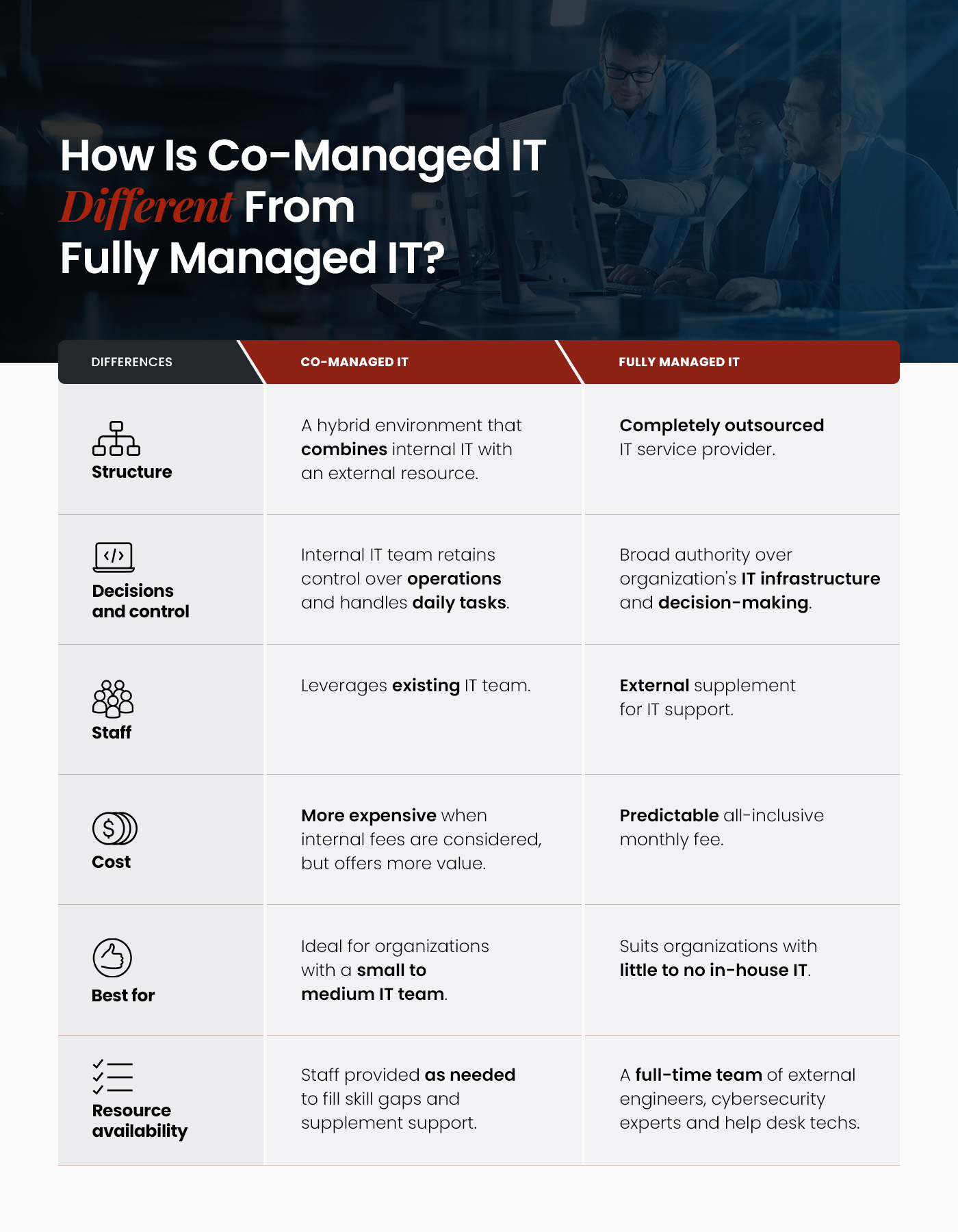
| Differences | Co-Managed IT | Fully Managed IT |
|---|---|---|
| Structure | A hybrid environment that combines internal IT with an external resource. | Completely outsourced IT service provider. |
| Decisions and control | Internal IT team retains control over operations and handles daily tasks. | Broad authority over organization’s IT infrastructure and decision-making. |
| Staff | Leverages existing IT team. | External supplement for IT support. |
| Cost | More expensive when internal fees are considered, but offers more value. | Predictable all-inclusive monthly fee. |
| Best for | Ideal for organizations with a small to medium IT team. | Suits organizations with little to no in-house IT. |
| Resource availability | Staff provided as needed to fill skill gaps and supplement support. | A full-time team of external engineers, cybersecurity experts and help desk techs. |
Rather than relinquishing control of operations, co-managed IT services allow MSPs and in-house teams to share responsibilities and workloads. It’s a partnership that ensures the health and safety of your IT environment, supported by external expertise and an internal knowledge base.
How Co-Managed IT Services Work
You’ve managed an internal IT team and have perhaps hired a fully outsourced one before. But how do these two different models work together? By combining these two teams, you’ll have the best of both worlds — knowledge and know-how from the internal team, and specialized expertise and advanced tech from the external team.
This hybrid IT environment works by:
- Scaling your IT resources to manage responsibilities more efficiently.
- Creating strategic focus that streamlines operations.
- Providing 24/7 surveillance, security and support.
Divided Responsibilities
Responsibilities and tasks are divided and shared between the teams.
Internal IT continues to handle the daily, strategic and business-specific operations. These tasks can include scheduled troubleshooting, software updates and strategy planning. As for the external IT provider, they manage the complex, monotonous or time-consuming tasks such as network monitoring, data backups, cybersecurity and after-hours desk support.
However, these divided tasks and responsibilities are determined by the types of IT support required for the internal team and what operations the organization wants to outsource.
Strategic Focus
Dividing tasks and responsibilities allows your internal team to focus on what they do best — keeping the organization’s IT operations running smoothly. By offloading network and infrastructure management, data backups and cybersecurity to a co-managed IT service provider, you’ll free up your internal team’s time and capacity to focus on high-value, strategic and innovative tasks that advance your business.
This strategic focus shift allows your IT department to move from maintenance to growth.
Scalability
When large-scale initiatives or an influx of requests come in, internal IT teams can feel overwhelmed and overloaded. To alleviate the pressure, provide support and increase capacity, external IT providers step in to offer additional manpower when it’s needed most.
By combining internal team and external resources, you can scale your IT infrastructure up or down depending on your specific needs. With this flexibility, there’s no need to hire additional full-time staff during your busiest periods, as integrating an external IT service will grow or contract with your organization.
The “Night Watch”
With an internal IT team, their work shifts end, leaving an unattended time window while they’re away from their desk. This is the opportune time for cyberattacks, after-hours ticket requests and system issues. To ensure continued monitoring and support, external managed service providers handle monitoring, maintenance and incident response during off-hours.
This approach provides around-the-clock monitoring, support coverage, security and system stability.
What’s Included in Co-Managed IT Services?
Co-managed IT covers a wide range of services, including network management, cloud services and strategic IT planning. However, service agreements between your organization and an MSP are customizable and can fit with your priorities and goals.
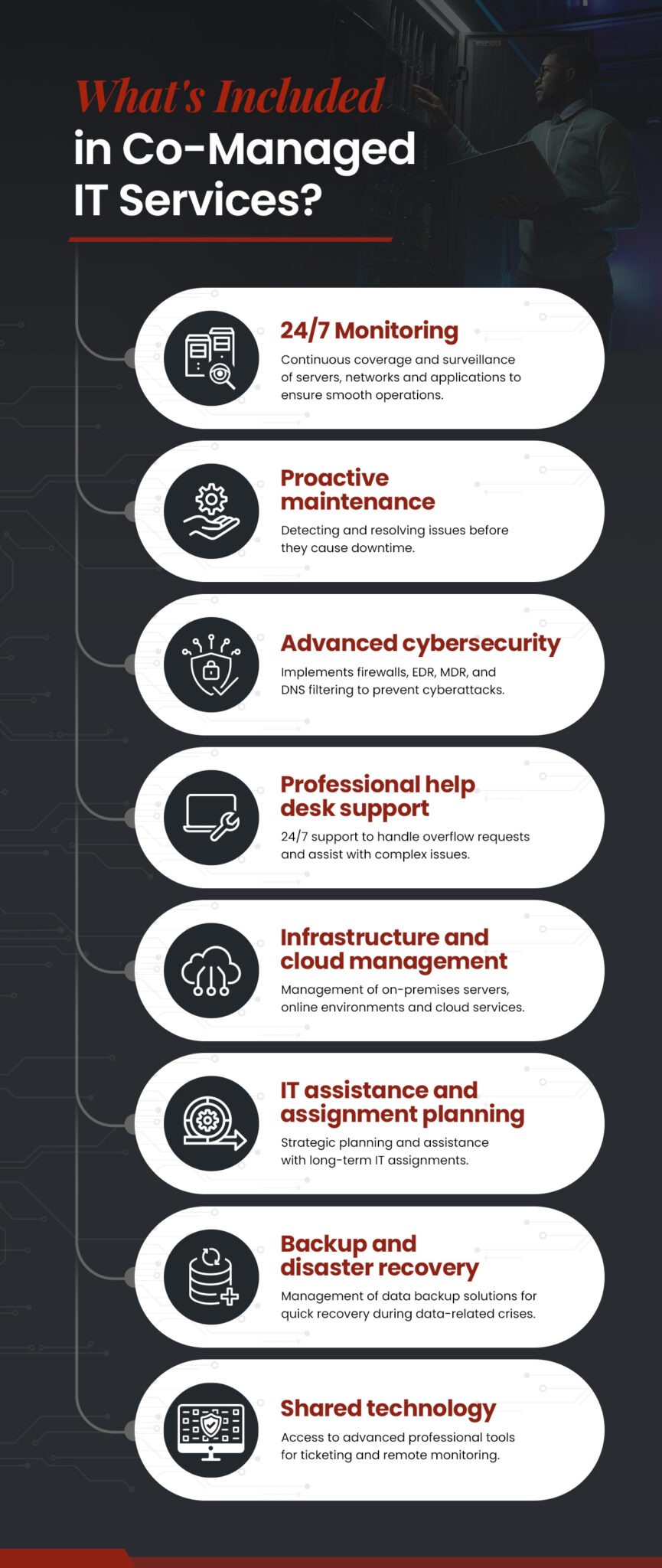
Services you can expect from a co-managed IT service provider include:
- 24/7 monitoring: Continuous coverage and surveillance of servers, networks and applications to ensure smooth operations.
- Proactive maintenance: Detecting and resolving issues before they cause downtime.
- Advanced cybersecurity: Implements firewalls, endpoint detection and response (EDR), managed detection and response (MDR), and DNS filtering to prevent cyberattacks.
- Professional help desk support: 24/7 support to handle overflow requests and assist with complex issues.
- Infrastructure and cloud management: Management of on-premises servers, online environments and cloud services.
- IT assistance and assignment planning: Strategic planning and assistance with long-term IT assignments.
- Backup and disaster recovery: Management of data backup solutions for quick recovery during data-related crises.
- Shared technology: Access to advanced professional tools for ticketing and remote monitoring.
When to Consider Co-Managed IT Services
Beyond being a necessity, IT services are an asset that can push your organization and in-house team forward. If you think you may need some additional IT support, there are many reasons to implement co-managed IT services in your organization. Whether to meet tight deadlines or capitalize on outsourced expertise to bridge a skill gap, this hybrid model can help solve various industry-related problems you may encounter.
Before adopting this approach, consider the current problems your internal IT team is facing and what business goals you have planned for the future. If any of the scenarios below sound familiar, it may be time to partner with an MSP.
Your In-House IT Team Is Overwhelmed
Small IT teams may struggle to keep up with changing demand while handling daily support tickets and routine tasks. Also, factors such as new assignments, spikes in user assistance, and fellow engineers on leave can affect performance and turnaround time. This limited capacity could lead to deadline extensions and disruptions, and even cause staff to feel burnt out or overworked.
To solve the backlog and relieve the pressure, co-managed IT steps in as an external IT department, ready to help wherever needed.
There’s a Knowledge Gap
Technology is always evolving and often changes at the drop of a hat. New systems and applications launch regularly. With these sudden developments, it can be difficult and time-consuming to keep up with the evolution and learn how these new technologies work.
Co-managed IT services allow your internal IT team to stay in the know and bridge knowledge gaps with specialized expertise from an MSP.
You Experience Rapid Business Growth
Your organization is growing, and it’s outpacing your internal team’s capacity. Although expansion is a good thing, it does strain your in-house IT department and slows progress. To keep the momentum going, you need to expand your IT team and hire new talent. However, this can be a time-consuming and even costly venture.
By hiring an external IT service provider, you can easily increase your team’s capacity. The beauty of an MSP is that its services can be scaled and tailored to meet your organization’s needs.
You Struggle to Manage Your Cybersecurity
Just as technology is always changing, so are cyber threats and security risks. Protecting your IT infrastructure is important. However, with your IT team focused on “keeping the lights on” and managing an influx of requests, it can be challenging to stay up to date with the latest security practices, which leaves your systems vulnerable.
If you don’t have the resources to continuously monitor and detect threats, co-managed IT services could be the solution. Adding an MSP to your IT team will provide the expertise and tools to safeguard your systems with 24/7 monitoring and advanced detection technology.
You Have IT Budget Limitations
Budget constraints may make it difficult to hire new full-time employees to increase capacity and drive progress. Your budget must also factor in your technology investments, overhead costs and licensing fees to operate efficiently. If you don’t have room to stretch your budget, co-managed IT services can be a cost-effective solution, depending on your requirements.
Although a co-managed IT service is an additional cost to your budget, it does add more value to your operations with its specialized expertise, access to advanced technology and tools, and ongoing monitoring.
The Benefits and Challenges of Co-Managed IT
Co-managed IT services go beyond increasing capacity. It’s about optimizing your IT infrastructure, reducing downtime and improving security. If you think this is the right service model for your business, you need to consider the benefits and challenges that come with it.
The benefits of collaborating with a co-managed IT service include:
- Minimized downtime: With round-the-clock, after-hours support and network and infrastructure management, your organization will be monitored and available day and night.
- Reduced burnout: Your internal team receives additional support, which allows them to regain capacity for other high-value tasks.
- Improved cost-efficiency: This option is more affordable than hiring full-time employees and lets businesses pay for the services they need.
- Increased service accessibility: Your internal team might not have the knowledge or skills to complete certain tasks, whereas the external team can provide them.
- Better flexibility: Co-managed IT is customizable and allows you to choose which tasks to be managed externally.
- Rapid response: Co-managed IT services accelerate recovery if you experience hardware failure, data breaches or cyberattacks. MSPs can reduce cyberattack risks by up to 50%.
As for co-managed IT challenges, you can expect:
- Extended initial adjustment period: MSPs need time to understand your internal IT team’s processes and procedures, and to find their footing within your organization.
- Coordination setbacks: Unclear communication, protocols and expectations can cause decision delays, inter-team conflicts and confusion about responsibilities.
- High initial investment: The co-managed IT partnership setup might be time-consuming and costly, but it’s cost-effective over time.
- Role confusion: An overlap in responsibilities can cause inefficiency if they’re not well-defined, and can lead to duplicated work and a lack of accountability.
- Complex management structure: Managing two separate teams can be challenging, especially when overseeing two sets of responsibilities.
- Internal staff hesitation: Your in-house team might feel threatened by the MSP and fear being replaced.
These challenges can be managed by ensuring clear communication, defining responsibilities and expectations, and providing reassurance that this augmented team is for support rather than replacement.
Is Co-Managed IT Right for Your Enterprise?
Implementing a co-managed IT service can be a win-win solution for your enterprise and internal IT team. You get to keep your internal team and maintain control over IT operations while reducing the risk of burnout, lost progress and downtime. This model offers operational efficiency, security, resilience and strategic direction, ensuring you stay ahead in a constantly evolving, technologically advanced world.
It’s a strategic investment that positions your organization for growth while supporting your existing internal team. If you face challenges such as limited knowledge, work overload, burnt-out staff, increased cyberattacks or outpaced IT resources due to rapid growth, co-managed IT services might be the right fit for your enterprise.